
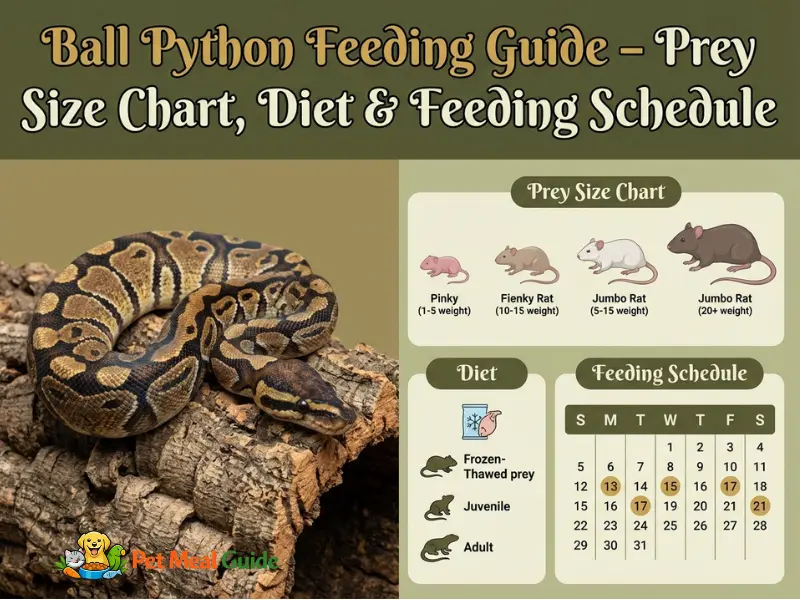
Ball Python Feeding Guide
The Ball Python (*Python regius*), also known as the Royal Python, is arguably the most popular pet snake in the world. Renowned for their incredibly docile temperament, manageable size, and thousands of stunning genetic color variations (morphs), they are the crown jewel of the reptile hobby. However, beneath their beginner-friendly reputation lies a trait that causes endless stress for keepers: Ball Pythons are notoriously picky eaters.
Unlike colubrids such as Corn Snakes or King Snakes that will eagerly consume food at any given opportunity, Ball Pythons have incredibly slow metabolisms. They are ambush predators that spend their lives in dark termite mounds in central and western Africa, waiting for precise, nutrient-dense meals. Understanding their biology, replicating their natural feeding triggers, and following a strict sizing chart is the only way to ensure your python thrives in captivity. Discover the Ultimate Reptile Feeding Guide for Healthy and Happy Pets
What is the proper ball python feeding guide and schedule?
Ball pythons are strict carnivores that eat whole prey, primarily mice and rats. Juvenile ball pythons are typically fed an appropriately sized mouse or small rat pup once every 5 to 7 days. As they mature, their metabolism slows down, meaning adult ball pythons only require a medium rat every 10 to 14 days.
- Hatchlings (0-6 months): Eat pinky, fuzzy, or hopper mice every 5–7 days.
- Juveniles (6-12 months): Eat adult mice or rat pups every 7 days.
- Adults (1+ years): Eat weaned, small, or medium rats every 10–14 days.
- Prey Size Rule: Prey should be roughly the same width as the thickest part of the python’s body.
The vast majority of reptile veterinarians strongly recommend feeding frozen-thawed rodents because they are significantly safer than live prey, eliminating the risk of the snake suffering severe bites or scratches during feeding.
In this guide, we will break down the science of Ball Python digestion. We will provide precise visual and weight-based feeding charts, discuss the critical transition from mice to rats, and offer an extensive troubleshooting guide for when your Ball Python inevitably decides to go on a hunger strike.
What Do Ball Pythons Eat? Natural Diet vs. Captivity
To understand how to feed your Ball Python, you must first understand how they have evolved to hunt. In the sub-Saharan regions of Africa, Ball Pythons are crepuscular and nocturnal ambush predators. They do not actively chase down their food. Instead, they find a secure hiding spot, curl into a tight ball, and wait for a heat signature to pass by.
In the wild, their diet consists primarily of African Soft-Furred rats (ASFs), shrews, gerbils, and occasionally ground-dwelling birds. Because they eat the entire animal, their diet is perfectly balanced. The bones provide essential calcium, the organs provide iron and vitamins (especially Vitamin A from the liver), and the muscle tissue provides dense protein.
According to comprehensive reptile care resources from the Smithsonian National Zoo, captive Ball Pythons do not need a varied diet. A steady, consistent diet of high-quality, lab-raised feeder mice and rats provides 100% of the nutrition your snake needs. Unlike lizards, you rarely need to dust a snake’s food with calcium powders, provided you are feeding whole prey.
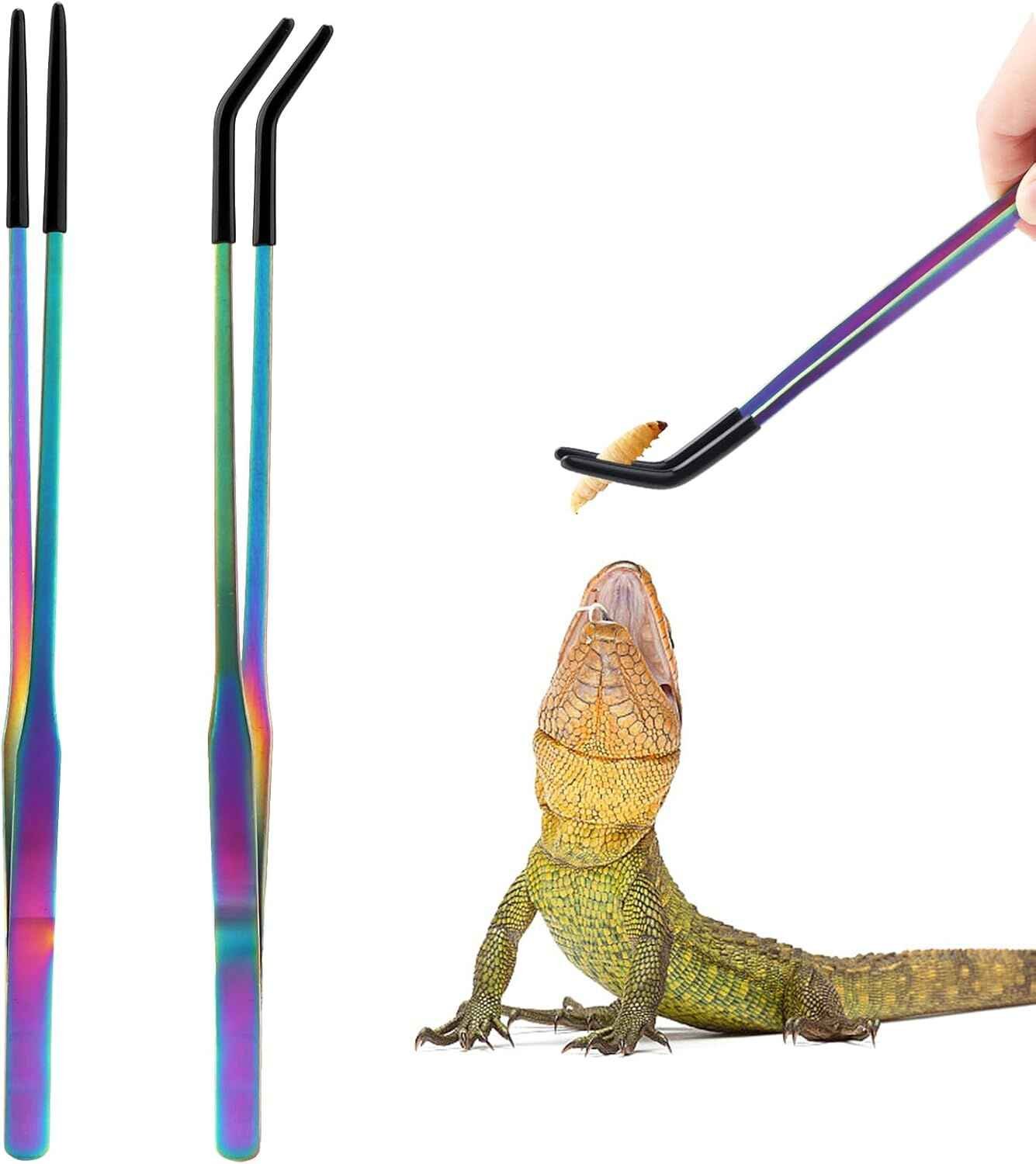
Essential Tool: Stainless Steel Reptile Feeding Tongs
Ball Pythons have incredibly poor eyesight. They rely almost entirely on their heat pits and sense of smell to strike. If your hand smells like a rat and radiates body heat, you risk a painful feeding response bite. Long, professional stainless steel feeding tongs allow you to safely dangle thawed rodents from a distance, keeping your fingers safe and mimicking the movement of live prey.
Check Price on AmazonThe “Mice to Rats” Transition: A Crucial Milestone
When you purchase a baby Ball Python from a breeder or a pet store, they are almost always eating mice (usually fuzzies or hoppers). Mice are perfectly fine for hatchlings because they are appropriately sized. However, as your Ball Python grows, their girth increases rapidly.
By the time a Ball Python reaches 12 to 18 months of age, they will have completely outgrown the largest adult mouse available. A massive adult female Ball Python can weigh upwards of 2,000 grams. If you try to sustain a large python on mice, you would have to feed them 4 or 5 mice at a time.
Feeding multiple small prey items is not recommended because:
- It severely taxes the snake’s digestive enzymes to break down multiple layers of fur and bone.
- Adult mice have a lower protein-to-fat ratio than young rats.
- Rats have thicker bone density, providing significantly more calcium for a growing python.
Therefore, transitioning your Ball Python from mice to rats is a mandatory milestone. You should aim to make this switch when the snake reaches roughly 150 to 200 grams in weight. The equivalent size of an adult mouse is a “Rat Pup.” Making the switch early ensures your python does not become addicted to the specific smell of mice.
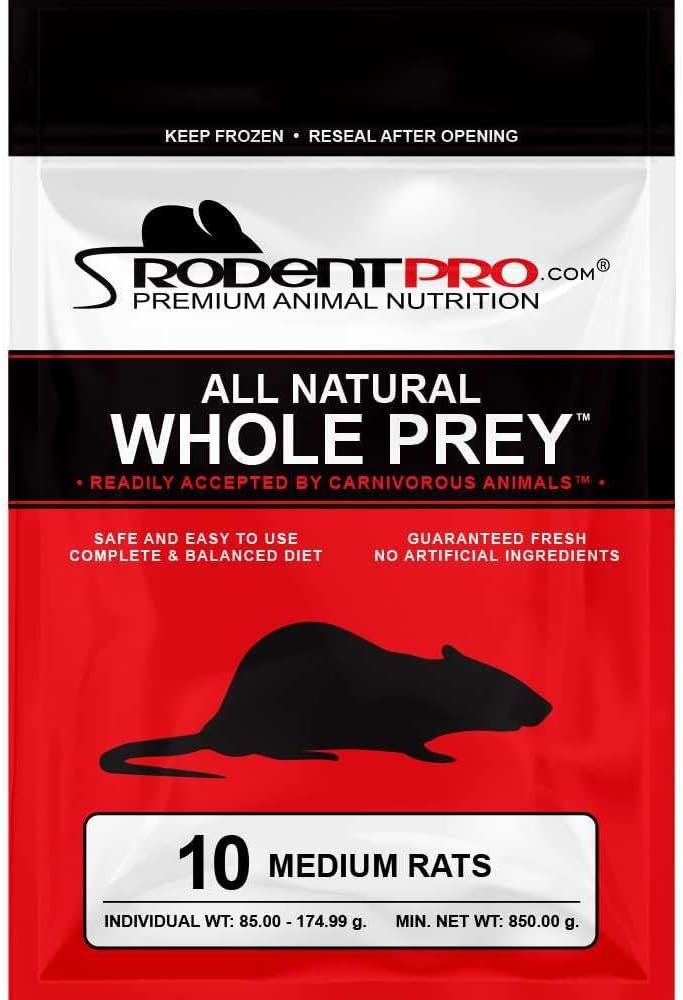
Premium Frozen Feeder Rats (Bulk Pack)
Sourcing high-quality rats from local pet stores is often incredibly expensive and unreliable. We highly recommend buying frozen feeder rats in bulk from dedicated online breeders. These rats are vacuum-sealed to prevent freezer burn, raised on lab-grade diets, and humanely euthanized. Buying in bulk guarantees you always have the exact right size on hand as your python rapidly gains weight.
Shop Bulk Feeder RatsBall Python Feeding Chart by Age, Weight, and Size
Determining the correct prey size is vital. If you feed a Ball Python a rat that is too large, their stomach cannot produce enough acid to digest the meal before it begins to rot. This results in fatal regurgitation. If you feed a meal that is too small, your python’s growth will stunt.
There are two primary methods for sizing prey:
1. The Visual Width Rule
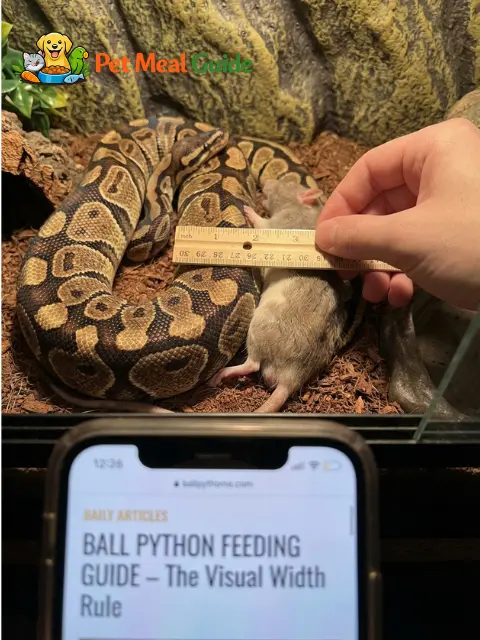
The standard, widely accepted rule in the hobby is that the prey item should be approximately the same width as the thickest part of the snake’s mid-body. Once the snake swallows the rodent, it should leave a noticeable, but not terrifyingly large, lump in their belly. If the scales are stretched so far that you can see wide strips of skin between them, the meal is too large.
2. The Weight Percentage Rule (Highly Recommended)
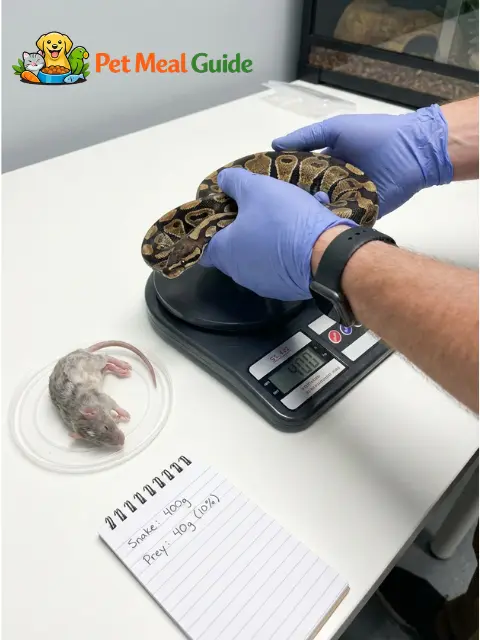
Visual estimation is often flawed. The most precise, scientific way to feed a Ball Python is by using a digital kitchen gram scale. You should weigh your python empty (after they have defecated). You then feed a prey item that weighs 10% to 15% of the snake’s total body weight.
For example, if your Ball Python weighs 400 grams, 10% of its body weight is 40 grams. Therefore, you should feed it a weaned rat that weighs roughly 40 grams.
Complete Ball Python Size & Weight Feeding Chart
| Python Weight | Python Age/Stage | Prey Type | Prey Weight (approx.) |
|---|---|---|---|
| 50g – 100g | Hatchling | Hopper Mouse / Rat Pinky | 8g – 12g |
| 100g – 200g | Early Juvenile | Adult Mouse / Rat Fuzzy | 13g – 20g |
| 200g – 350g | Juvenile | Rat Pup | 20g – 30g |
| 350g – 500g | Late Juvenile | Weaned Rat | 30g – 45g |
| 500g – 1,000g | Sub-Adult | Small Rat | 45g – 80g |
| 1,000g – 1,500g+ | Adult Male / Small Female | Medium Rat | 80g – 140g |
| 1,500g – 2,500g+ | Large Adult Female | Large Rat | 140g – 180g |
Note on Large Rats: Very few Ball Pythons ever need to eat “Large Rats.” Large rats carry a tremendous amount of fat. Feeding large rats routinely often leads to severe obesity and fatty liver disease. A medium rat every two weeks is perfectly sufficient for 95% of adult Ball Pythons.
For a broader comparison across different snake species, please review our comprehensive Snake Feeding Guide.
Ball Python Feeding Schedule: How Often to Feed
The second biggest mistake owners make, right after feeding the wrong size, is feeding their snake too frequently. A Ball Python is incredibly sedentary. They do not run on hamster wheels to burn off calories. If you overfeed them, they will become morbidly obese, drastically shortening their lifespan.
Feeding frequency scales inversely with age. As the snake gets larger, its metabolism slows down, and the prey items become denser. Therefore, the time between meals must increase.
- Hatchlings (Up to 200g): Feed every 5 to 7 days. At this stage, the python is utilizing massive amounts of cellular energy to lengthen its skeleton and build foundational muscle.
- Juveniles (200g to 500g): Feed every 7 days. Growth begins to stabilize. A strict weekly schedule is perfect here.
- Sub-Adults (500g to 1,000g): Feed every 10 days. The snake is nearing sexual maturity. Feeding a small rat every week at this stage often leads to rapid, unhealthy weight gain.
- Adults (1,000g+): Feed every 14 to 21 days. Once a Ball Python is fully grown, they require very little caloric intake to maintain their weight. A medium rat every two to three weeks mimics their natural gorge-and-fast lifestyle in the wild.
Live vs. Frozen-Thawed Prey: The Ultimate Debate
If you ask a group of reptile keepers whether you should feed live rats or frozen-thawed rats, you will likely spark a fierce debate. However, from a modern veterinary and animal welfare perspective, the consensus is incredibly clear.
According to the Association of Reptile and Amphibian Veterinarians (ARAV), rodent bites are a leading cause of severe trauma in pet snakes. A rat’s incisors can easily pierce a snake’s eye, sever the spine, or cause deep lacerations that lead to fatal sepsis.
Benefits of Frozen-Thawed Prey:
- 100% Injury Prevention: Your python is completely safe during mealtime.
- Eradication of Parasites: Deep-freezing rodents kills internal parasites, mites, and tapeworms.
- Humane Considerations: Frozen rodents are humanely euthanized using painless CO2 gas by professional breeders, which is far more ethical than the trauma of constriction.
Step-by-Step: How to Safely Thaw and Feed Frozen Rodents
Ball Pythons have highly sensitive heat pits located along their upper and lower lips. They use these to detect the infrared heat signature of a mammal. If you present them with a frozen-thawed rat that is room temperature (75°F), they will likely ignore it, as it does not register as “alive.”
Properly thawing and warming the rodent is the key to triggering a feeding response.
- The Cold Thaw: Remove the frozen rat from the freezer, place it in a watertight ziplock bag, and submerge it in a bowl of cold tap water for several hours (or leave it in the fridge overnight). Never use a microwave, as it cooks the meat and can cause the rodent to explode.
- The Squish Test: Squeeze the belly of the rat. It must be completely soft. If there is a hard, icy core, it is not ready. Feeding a partially frozen rat will lower the python’s core temperature and cause regurgitation.
- The Warm-Up: Once fully thawed, replace the cold water with hot tap water (approx. 100°F – 105°F). Submerge the bagged rat for 15 minutes. This safely raises the internal temperature to mimic a live animal.
- The Presentation: Dry the rat off (wet rats pick up substrate that can cause impaction). Using your tongs, grasp the rat by the scruff of the neck. Gently dangle and twitch it slightly outside the python’s hide. The heat signature and movement will trigger the strike.
For a highly detailed, step-by-step breakdown of this process, please review our guide on How to Thaw Frozen Mice for Snakes Safely.
Video Guide: Feeding Frozen Rodents to Ball Pythons
Seeing the proper technique is often more helpful than reading about it. The video below demonstrates how to properly temp-check a thawed rat and perform the “zombie dance” to stimulate a Ball Python’s natural ambush instincts.
The Notorious Ball Python Hunger Strike (Why They Refuse Food)
If you own a Ball Python long enough, you will eventually experience a “hunger strike.” A Ball Python refusing food is the number one cause of anxiety for keepers. First, take a deep breath. A healthy adult Ball Python can go 6 months without eating and lose very little body weight. They are built to survive extreme droughts and famines in Africa.
If your snake is refusing food, systematically check the following parameters:
1. Husbandry and Temperatures Are Incorrect
Snakes are ectotherms; they need external heat to power their digestive system. If your enclosure is too cold, the snake instinctually knows that eating will result in the food rotting in its stomach. A Ball Python requires a hot spot of 88°F to 92°F and an ambient cool side of 78°F to 80°F. If your temperatures are too low, fix them immediately.
2. The Snake is Going into Shed (Ecdysis)
If your python’s colors look dull, its belly is pink, and its eyes have turned a cloudy, milky blue, it is preparing to shed its skin. During this “in blue” phase, the snake is practically blind and feels incredibly vulnerable. 90% of Ball Pythons will refuse food while in shed. Simply wait until they slough off the old skin and offer food a few days later.
3. Seasonal Fasting (The Winter Wall)
Ball Pythons are highly attuned to barometric pressure and seasonal changes. Many adult males (and some females) will completely stop eating from November through March. This is tied to their natural breeding instincts. If your husbandry is perfect and the snake is not losing rapid weight, simply monitor them. They will resume eating when spring arrives.
4. Stress and Insecurity
Ball Pythons are shy, timid creatures. If you put a baby python in a massive 120-gallon glass tank with no hiding spots, it will be terrified. A stressed snake will not eat. Ensure your enclosure is heavily cluttered with fake plants and features at least two tight-fitting, dark hides (one on the hot side, one on the cool side). Additionally, stop handling the snake entirely until it eats three consecutive meals.
Advanced Troubleshooting: Tricks for Picky Eaters
If you have corrected all husbandry issues, and the snake is losing weight (more than 10% of its total body mass), it is time to try some advanced feeding tricks.
- Braining: Using a sterile needle, puncture the skull of the thawed rat and squeeze slightly to expose a tiny amount of brain matter. The scent is incredibly potent and often triggers a ravenous response.
- Scenting with ASF: Ball Pythons naturally hunt African Soft Furred rats. You can buy frozen ASFs online, or you can buy “ASF scent juice” to rub on a standard Norway rat to trick the python.
- Night Feeding: Ball Pythons are nocturnal. Try waiting until 11:00 PM, turn off all the lights in the room, and offer the rat in total darkness.
- Drop Feeding: Some pythons are terrified of the feeding tongs. Heat the rat perfectly, place it on a small paper plate inside the enclosure right outside the snake’s hide, turn off the lights, and leave the room overnight. Often, the rat will be gone by morning.
Post-Feeding Safety and Handling Rules
Congratulations, your python ate! However, the critical care period is not over. Digestion requires a massive amount of energy, and the snake’s body undergoes severe physiological changes to process a whole rat.
In the wild, a snake with a full belly is slow and vulnerable to predators. If they are attacked, their natural defense mechanism is to violently regurgitate (throw up) the meal so they can slither away quickly to survive. If you pick up your snake to show your friends right after it eats, the physical compression of your hands on its stomach and the stress of being held will trigger this exact regurgitation response.
Regurgitation is a severe medical event. It brings up highly potent stomach acids that burn the snake’s esophagus and severely dehydrates them. If your snake regurgitates, you must wait a full 14 days before attempting to feed them again, allowing their throat to heal. To prevent this entirely, simply leave the snake alone in its heated enclosure for two days post-feeding.
Frequently Asked Questions (FAQ)
How often should you feed a ball python?
Juvenile ball pythons under one year of age should be fed every 5 to 7 days to support rapid skeletal growth. As they mature into adults (over 1,000 grams), their metabolism slows significantly, and they should be fed an appropriately sized rat every 10 to 14 days to prevent obesity.
What do ball pythons eat?
Ball pythons are obligate carnivores that eat whole prey, primarily mice, rats, and African Soft Furred rats (ASFs). They digest the entire animal, including the bones, organs, and fur, which provides them with a perfectly balanced diet. In captivity, high-quality frozen-thawed rodents are the standard diet.
What size prey should a ball python eat?
The standard visual rule is that the prey should be roughly the exact same width as the thickest part of the python’s mid-body. For a more scientific approach, use a gram scale and feed a rodent that weighs roughly 10% to 15% of the snake’s total empty body weight.
Is frozen prey really safe for ball pythons?
Yes, frozen-thawed prey is vastly superior and safer than live prey. It eliminates the risk of your snake being bitten or scarred by a terrified rodent, kills harmful internal parasites, and is considered the most humane feeding method by veterinary professionals.
Why is my ball python striking the rat but not wrapping it?
This is called a “defensive strike.” If the rat is too cold, or if the python feels threatened by you or the tongs, it will strike the rat simply to tell it to “go away” rather than to eat it. Ensure the rat is heated to 100°F and try to approach slower and calmer.
Authoritative Resources & Further Reading
To ensure the utmost health and safety of your reptile, the protocols and biological data in this guide align with the husbandry standards established by leading zoological and veterinary authorities:
- Smithsonian National Zoo: Ball Python Natural History and Care
- Association of Reptile & Amphibian Veterinarians (ARAV): Guidelines on captive reptile diets and the dangers of live prey.
- RSPCA (Royal Society for the Prevention of Cruelty to Animals): Comprehensive welfare guides and ethical feeding practices for exotic pets.