
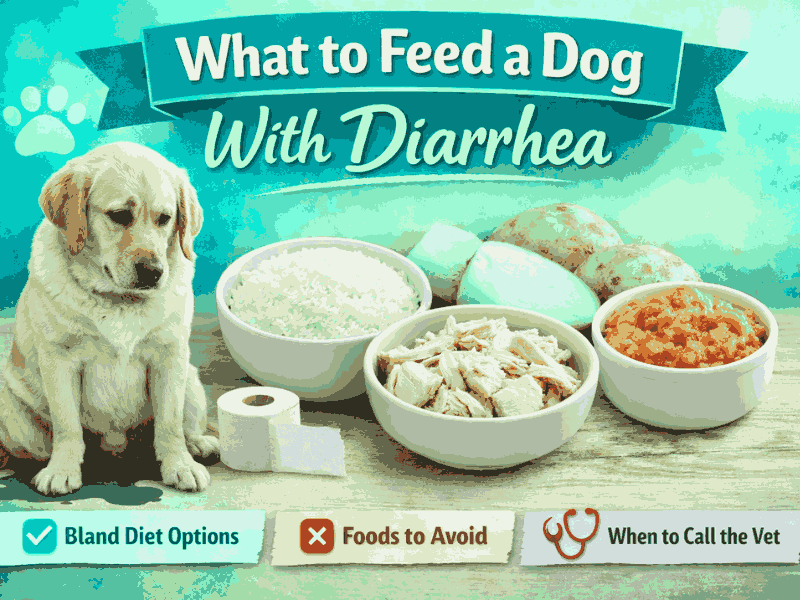
What to Feed a Dog With Diarrhea: A Vet-Informed Guide
Quick Answer
For a dog with mild diarrhea who is otherwise acting normal, drinking water, and not vomiting, most vets now say there’s no need to withhold food at all — you can go straight to a bland, low-fat diet like boiled chicken and plain white rice, fed in small, frequent meals. A short fast of up to 12 hours is sometimes used if vomiting is also present, but longer fasting is now discouraged because it can slow gut healing.
Call a vet promptly, rather than managing this at home, if you see:
- Blood in the stool or stool that looks black and tarry
- Vomiting, lethargy, or refusal to drink water
- Diarrhea lasting more than 48 hours
- A puppy, senior dog, or a dog with an existing health condition
Never give over-the-counter anti-diarrheal medication without checking with a vet first — some, like loperamide (Imodium), can be dangerous for certain breeds.
Diarrhea is one of the most common reasons dogs see a vet, and in most cases it’s manageable at home with the right food. But “bland diet” advice has genuinely changed in the last few years — the old instructions to fast a dog for a full day are no longer what most vets recommend — and knowing the difference between a mild tummy upset and a medical emergency matters.
This guide covers what to feed a dog with diarrhea, current fasting guidance, a real veterinary stool-scoring chart, how to recognize dehydration, when bloody diarrhea is an emergency, and which over-the-counter medications are and aren’t safe to use without a vet’s input.
How Common Is Dog Diarrhea? What the Latest Research Shows
A 2025 study from the Royal Veterinary College’s VetCompass Programme, published in the peer-reviewed journal PLOS One, analyzed veterinary records from more than two million dogs in the UK to understand how often diarrhea occurs and how it’s treated.
Key Findings (O’Neill et al., PLOS One, 2025)
The study also found that certain breeds carried higher odds of acute diarrhea, including the Maltese, Miniature Poodle, Cavapoo, German Shepherd Dog, Yorkshire Terrier, and Cockapoo, while Jack Russell Terriers and Chihuahuas had lower odds. Scavenging, underlying gastroenteritis, medication reactions, and sudden diet changes were the most common triggers identified.
What Causes Dog Diarrhea?
Diarrhea isn’t a disease itself — it’s a symptom. According to the American Kennel Club, common causes include:
- Dietary indiscretion: eating garbage, spoiled food, table scraps, or something toxic. This is the single most common trigger.
- Sudden diet changes: switching foods too quickly, without a gradual transition.
- Stress: boarding, travel, or routine changes can trigger “stress colitis.”
- Infections: bacterial (Salmonella, E. coli, Clostridium), viral (parvovirus, distemper), or parasitic (giardia, hookworms, roundworms, coccidia, whipworms).
- Food allergy or intolerance: certain proteins can trigger digestive upset in sensitive dogs.
- Chronic conditions: inflammatory bowel disease (IBD), pancreatitis, and other underlying illnesses tend to cause recurring rather than one-off diarrhea.
- Medications: some drugs, including recently started antibiotics, can cause diarrhea as a side effect.
Puppies should always be up to date on vaccinations — parvovirus is a life-threatening cause of diarrhea that is largely preventable.
Stool Score Chart: What Your Dog’s Poop Is Telling You
Veterinarians commonly use a standardized 7-point fecal scoring scale, popularized by Purina, to describe stool consistency objectively rather than guessing. A score of 2 is considered ideal.
7-Point Fecal Scoring Scale
Adapted from the Purina Fecal Scoring Chart, as published by the Ohio State University Veterinary Medical Center.
| Score | Description | What it usually means |
|---|---|---|
| 1 | Very hard, dry, individual pellets | Constipation |
| 2 | Firm but not hard, pliable, segmented | Ideal, healthy stool |
| 3 | Log-shaped, moist surface, holds form | Still normal / slightly soft |
| 4 | Very moist, soggy, log-shaped, loses form when picked up | Soft stool / early diarrhea |
| 5-6 | Piles rather than logs, loses shape, or has texture but no defined shape | Diarrhea |
| 7 | Watery, no texture, flat puddle | Severe diarrhea — dehydration risk rises quickly |
Should You Fast Your Dog First?
This is the part of the standard advice that has genuinely shifted. The old instruction was a blanket 24-48 hours of no food. Current guidance from multiple veterinary sources, including PetMD, is more nuanced:
- If your dog only has diarrhea, isn’t vomiting, and is otherwise acting normal: many vets say there’s no need to withhold food at all — go straight to a bland diet.
- If vomiting is also present: a brief fast of up to 12 hours is often reasonable for a healthy adult dog, since it reduces how often food is brought back up.
- Fasting longer than 24-48 hours is discouraged. The intestinal lining depends on food passing through it to stay healthy; prolonged fasting can slow recovery.
- Water is never withheld. Diarrhea causes ongoing fluid loss, and dehydration is what turns a manageable problem into an emergency.
A puppy under about 3-4 months old (fasting risks dangerous blood-sugar drops in small/toy breed puppies especially), a senior dog, pregnant or nursing, diabetic, or has any other known health condition. For these dogs, ask your vet before withholding food at all.
Bland Diet: What to Feed and How Much
Once it’s time to feed (immediately, or after a short fast), the goal is food that’s low-fat, easy to digest, and won’t add extra work for an inflamed gut.
Best Bland Foods for a Dog With Diarrhea
- Boiled white rice (plain, no salt, butter, or seasoning)
- Boiled, skinless chicken breast (plain, shredded)
- Plain canned pumpkin (100% pumpkin, not pie filling) in small amounts
- Plain boiled potato (peeled, no butter or salt)
- Low-fat cottage cheese, in small amounts
- Plain, unseasoned boiled turkey (as a chicken alternative)
| Step | Guidance |
|---|---|
| Ratio | A commonly used starting point is about 1 part boiled chicken to 2 parts plain white rice. |
| Portion | Start small — roughly a quarter of your dog’s normal daily food amount. |
| Frequency | Split into 4 or more small meals through the day rather than 1-2 large ones. |
| Duration | Feed the bland diet for 2-3 days, then gradually mix in increasing amounts of regular food. |
| If it’s not improving | Contact your vet rather than continuing bland food indefinitely — chronic diarrhea needs a diagnosis, not just a longer bland-diet trial. |
70% boiled white rice + 30% boiled lean protein (chicken or turkey), with 1-2 teaspoons of plain pumpkin optional. Feed for 2-3 days maximum, then transition slowly back to your dog’s regular food over another 2-3 days by mixing increasing proportions together.
What to Feed a Dog With Diarrhea and Vomiting
Vomiting changes the calculus, since it means food (and fluid) may not stay down.
- Withhold food for up to 12 hours, offering small, frequent sips of water throughout.
- Once vomiting has stopped for several hours, offer a small amount of boiled chicken and rice.
- If that stays down, gradually increase portion size over the next 2-3 days.
- If vomiting continues, recurs, or your dog can’t keep water down, contact a vet — repeated vomiting alongside diarrhea raises the risk of dehydration quickly and can point to a more serious underlying cause.
Bloody Diarrhea: When It’s a Medical Emergency
Bloody diarrhea is not something to manage with a bland diet alone. In its most serious form, it can indicate acute hemorrhagic diarrhea syndrome (AHDS) — formerly called hemorrhagic gastroenteritis (HGE) — a condition described by the Merck Veterinary Manual.
| Aspect | What’s known |
|---|---|
| What it looks like | Sudden, profuse bloody diarrhea often described as resembling “raspberry jam,” sometimes with vomiting and abdominal pain |
| Who’s most at risk | Small and toy breeds are overrepresented, including Yorkshire Terriers, Miniature Pinschers, Miniature Schnauzers, Miniature Poodles, and Maltese; median age around 5 years |
| Suspected cause | Not fully understood; associated with Clostridium perfringens toxin activity and increased intestinal permeability |
| Why it’s urgent | Rapid fluid and protein loss into the gut can progress to hypovolemic shock without prompt treatment |
| Vet treatment | Aggressive IV fluid therapy, anti-nausea medication, and nutritional support; prognosis is generally good with early treatment |
If you see blood in your dog’s stool
Contact a vet or emergency animal hospital right away, especially if it’s paired with vomiting, lethargy, pale gums, or a painful abdomen. Don’t wait to see if it resolves on its own — early treatment is strongly linked to a good outcome.
Foods to Avoid During Recovery
Avoid these completely until your dog’s stool is back to normal:
- Fatty or fried foods (a common trigger for pancreatitis)
- Milk, cheese, and cream (many adult dogs are lactose intolerant)
- Table scraps and seasoned leftovers
- Raw food or anything new/untested
- Treats and flavored chews
- Sudden switches to a different commercial food
- High-fiber additions like large amounts of pumpkin or sweet potato in the very earliest, most acute stage — these can sometimes worsen loose stool before they help
Do Pumpkin and Probiotics Actually Help?
Pumpkin
According to the American Kennel Club, pumpkin’s soluble fiber (including pectin) adds bulk to stool by absorbing water, and its fermentation in the gut produces short-chain fatty acids that support the intestinal lining. It also acts as a prebiotic, feeding beneficial gut bacteria. That makes it a reasonable, low-risk addition for mild diarrhea — but it isn’t a treatment for anything more serious, and very high-fiber additions can sometimes make acute diarrhea worse rather than better in the first day or two.
Probiotics
Evidence here is genuinely mixed depending on the specific strain. A controlled, double-blinded shelter study published in the Journal of Veterinary Internal Medicine found that dogs and cats given the probiotic strain Enterococcus faecium SF68 were less likely to develop diarrhea lasting two or more days than animals given a placebo. That’s real, peer-reviewed evidence for one specific, well-studied strain — it doesn’t mean every probiotic product on a shelf has equivalent evidence behind it. A vet-recommended, clinically studied probiotic is a safer bet than picking one at random.
Imodium, Pepto Bismol & Other OTC Medications
Imodium (Loperamide)
Loperamide isn’t FDA-approved for dogs but is sometimes used by vets off-label for non-infectious diarrhea. According to veterinarian-reviewed guidance published by GoodRx, it is not safe for dogs with the MDR1 gene mutation — a mutation common in Collies, Australian Shepherds, Shetland Sheepdogs, Old English Sheepdogs, and other herding breeds — because it can cross into the brain and cause serious sedation or neurological toxicity. It should also never be used if infection, a foreign body obstruction, or toxin ingestion is suspected, since it can trap the underlying problem inside the gut. Never give it without your vet’s input, and never guess a human dose.
Pepto Bismol (Bismuth Subsalicylate)
According to AKC Chief Veterinary Officer Dr. Jerry Klein, he rarely recommends Pepto Bismol for dogs because its salicylate content can cause gastric bleeding, and the bismuth turns stool black — which can mask the very bleeding it might be causing. It should not be given to dogs with bleeding disorders, pregnant or nursing dogs, or dogs already taking NSAIDs like carprofen or deracoxib. If a vet does approve it, it’s typically limited to one or two doses.
The safest general rule: don’t reach for a human medicine cabinet for a dog with diarrhea. Call your vet or an emergency line first — they can tell you within minutes whether something is appropriate for your specific dog.
Helpful Product Categories (Vet-Discuss Before Use)
These are categories of products commonly used to support dogs recovering from diarrhea. Check suitability with your vet, especially for puppies, seniors, or dogs on other medications.
Hill’s Science Diet Sensitive Stomach & Skin
A widely used, gentle-on-digestion commercial formula, often suggested as a longer-term food for dogs prone to loose stools once acute diarrhea has resolved.
Purina Pro Plan Sensitive Skin & Stomach
Formulated around easy-to-digest protein and added probiotics; a common vet-aisle recommendation for dogs with recurring digestive sensitivity.
Pumpkin / Fiber Stool-Firming Supplements
Shelf-stable fiber blends (such as Bernie’s Perfect Poop) can supply the same soluble-fiber mechanism as plain canned pumpkin in a more convenient format.
Vet-Studied Probiotic Strains (e.g., Enterococcus faecium SF68)
Look for products listing a specific, clinically studied strain rather than a generic “probiotic blend” — strain matters more than marketing claims here.
This section names product categories and example brands for informational purposes. Add your own affiliate links and disclosure (“As an Amazon Associate/affiliate, we may earn a commission…”) before publishing, per FTC guidelines.
Dehydration: Signs and How to Check at Home
Diarrhea’s biggest real danger is dehydration, not the loose stool itself. Two quick home checks can help you gauge severity:
- Skin tent test: Gently lift the skin over your dog’s shoulders and release. In a hydrated dog it snaps back immediately; in a dehydrated dog it falls back slowly or stays “tented.”
- Gum check: Healthy gums are pink and moist. Press a finger to the gum — color should return within 1-2 seconds (capillary refill time). Dry, tacky gums or a refill time over 2 seconds point to dehydration.
| Estimated Fluid Loss | What You May See | Action |
|---|---|---|
| Under 5% | Often hard to detect; maybe slightly tacky gums, mild low energy | Watch closely, offer water |
| ~5-6% | Mild skin tenting, dry/tacky gums, lethargy | Call your vet |
| ~8% | Obvious skin tenting, dry gums, sunken eyes, weakness, slow capillary refill | Vet visit needed same day |
| 10%+ | Collapse, shock, very weak pulse | Emergency vet immediately |
If your vet approves it, unflavored Pedialyte can be offered in small amounts to help replace lost electrolytes — flavored versions can contain xylitol, which is toxic to dogs, so plain/unflavored only.
When to Call a Vet Immediately
Contact a vet promptly if you see:
- Diarrhea lasting more than 48 hours
- Blood in the stool, or stool that looks black and tarry
- Vomiting alongside diarrhea, especially if repeated
- Lethargy, weakness, or a painful/tense abdomen
- Signs of dehydration (see table above)
- Refusal to drink water
- A puppy, senior dog, or a dog with a known health condition
- Diarrhea that resolves and then keeps coming back
Frequently Asked Questions
Yes. Plain, boiled white rice is one of the most commonly recommended bland foods because it’s low-fat and easy to digest, typically paired with a lean protein like boiled chicken in roughly a 2:1 rice-to-protein ratio.
Plain canned pumpkin’s soluble fiber can help firm stool and support gut bacteria, and it’s a reasonable low-risk addition for mild cases — but it’s not a substitute for veterinary care if other symptoms like vomiting, lethargy, or blood in the stool are present.
Not necessarily. Current guidance has moved away from routine long fasting — if there’s no vomiting, many vets say there’s no need to withhold food at all. A brief fast (up to 12 hours) is sometimes used when vomiting is also present, but fasting beyond 24-48 hours is now discouraged.
Mild, diet-related diarrhea often clears up in 24-48 hours with a bland diet, and most acute cases resolve within two to five days. A large UK study found roughly 80% of diarrhea cases resolved after a single vet visit. Anything lasting beyond 48 hours warrants a vet check.
Only under veterinary guidance. It’s not FDA-approved for dogs and can cause serious neurological toxicity in dogs with the MDR1 gene mutation, common in Collies, Australian Shepherds, and other herding breeds. It also shouldn’t be used if an infection, obstruction, or toxin ingestion is possible.
Only with veterinary guidance. Its salicylate content can cause gastric bleeding, and it turns stool black, which can mask real bleeding. It’s not appropriate for dogs with bleeding disorders, pregnant/nursing dogs, or dogs on NSAIDs.
It can range from minor streaking to profuse, “raspberry jam”-like bloody diarrhea seen in acute hemorrhagic diarrhea syndrome (AHDS), a serious condition most common in small and toy breeds. Any bloody diarrhea, especially with vomiting or lethargy, needs emergency vet attention.
No. It’s meant as a short-term recovery meal, not balanced daily nutrition. If diarrhea is chronic or recurring, a vet may recommend a prescription gastrointestinal diet instead of an ongoing homemade bland diet.
Yes — boarding, travel, or routine changes can trigger stress-related diarrhea, sometimes called stress colitis. It usually improves with a bland diet and calmer routine, but persistent cases still deserve a vet check to rule out other causes.
Unflavored Pedialyte can be offered in small amounts to help replace electrolytes, but only with your vet’s approval. Flavored versions can contain xylitol, which is toxic to dogs, so plain, unflavored formulations are the only option to consider.
See a vet if diarrhea lasts more than 48 hours, contains blood or looks black/tarry, comes with vomiting or lethargy, or affects a puppy, senior, or dog with an existing health condition — or any time your dog seems painful or won’t drink water.
Some evidence supports specific strains. A controlled shelter study published in the Journal of Veterinary Internal Medicine found the probiotic Enterococcus faecium SF68 reduced the likelihood of diarrhea lasting two or more days. Not every probiotic product has equivalent evidence, so a clinically studied, vet-recommended strain is the safer choice.
Sources
- O’Neill DG, Prisk LJ, Brodbelt DC, Church DB, Allerton F. “Epidemiology and clinical management of acute diarrhoea in dogs under primary veterinary care in the UK.” PLOS One, 2025.
- PetMD — What to Feed a Dog With Diarrhea
- American Kennel Club — Doggie Diarrhea
- American Kennel Club — Can Pumpkin Help With Dog Diarrhea?
- American Kennel Club — Is Pepto Bismol Safe for Dogs? (Dr. Jerry Klein, DVM)
- GoodRx Health — Imodium for Dogs (reviewed by Rhiannon Koehler, DVM)
- Merck Veterinary Manual — Acute Hemorrhagic Diarrhea Syndrome in Dogs
- VCA Animal Hospitals — Acute Hemorrhagic Diarrhea Syndrome in Dogs
- Bybee SN, Scorza AV, Lappin MR. “Effect of the Probiotic Enterococcus faecium SF68 on Presence of Diarrhea in Cats and Dogs Housed in an Animal Shelter.” Journal of Veterinary Internal Medicine, 2011.
- Ohio State University Veterinary Medical Center — Purina Fecal Scoring Chart
1 thought on “What to Feed a Dog With Diarrhea”