
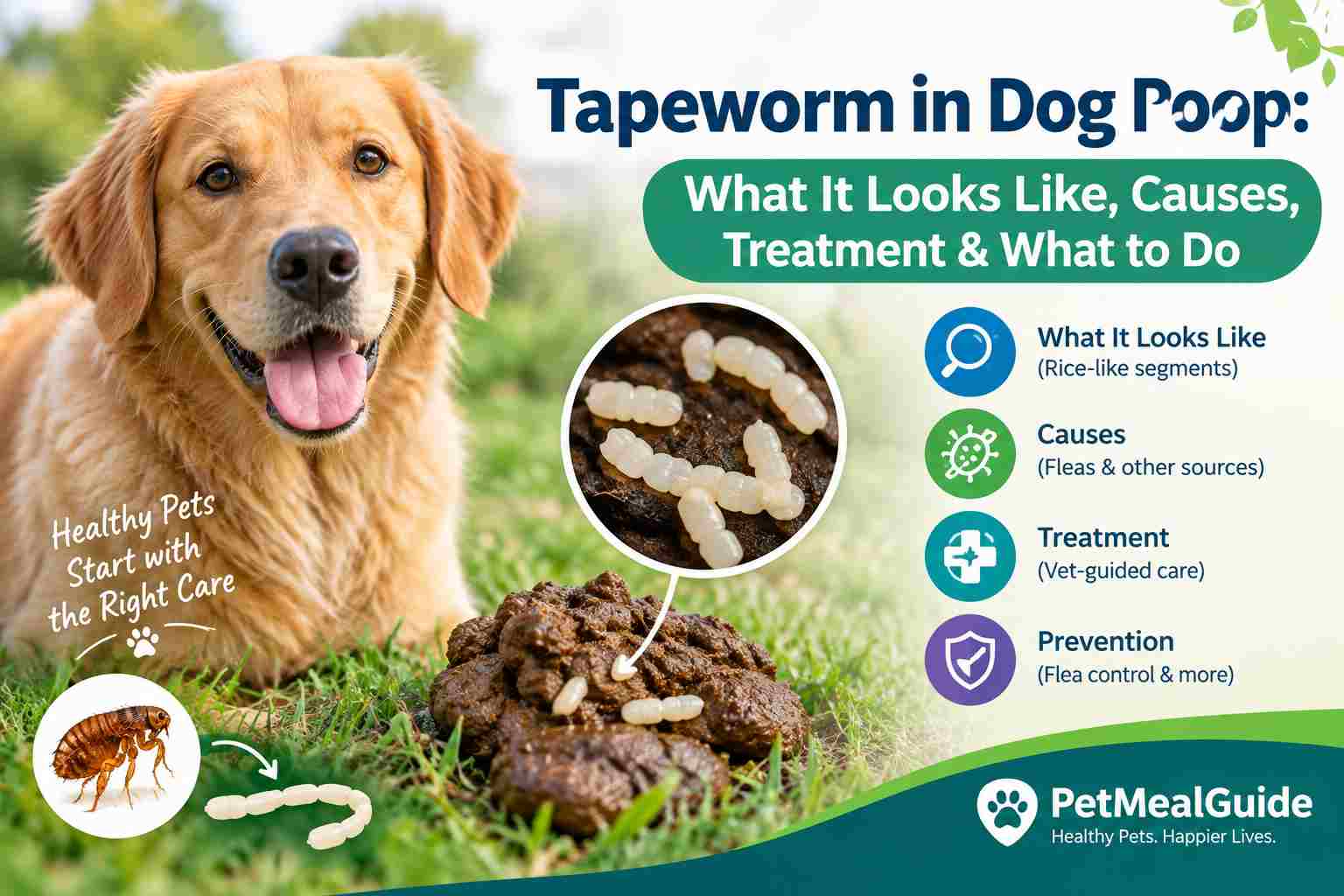
Tapeworm in Dog Poop
Tapeworm segments in dog poop typically look like small, moist, white or cream-colored grains of rice or cucumber seeds that can slowly expand, contract, or crawl. When dry, they resemble hard, golden-brown sesame seeds stuck to the stool, perianal fur, or bedding. The common flea tapeworm, Dipylidium caninum, is closely tied to fleas and tapeworms in dogs and cats and is acquired when a dog swallows an infected flea. If you see suspected segments, contact your veterinarian for targeted cestocide medication and strict flea control.
What Does Tapeworm in Dog Poop Look Like?
When dog owners discover a tapeworm in dog poop, they are rarely seeing an entire intact worm. Adult tapeworms live anchored within the mucosal lining of the dog’s small intestine, where they can reach lengths from several inches up to several feet. What actually passes into your dog’s waste are individual, egg-bearing reproductive segments called proglottids.
Because proglottids change dramatically depending on moisture levels, recognizing them requires understanding both their fresh and dried states.
Fresh Tapeworm Segments
- Shape: Flattened, rectangular to oval, closely resembling an elongated cucumber seed or a grain of white rice.
- Color: Moist, pearlescent white, cream, or pale pinkish-translucent.
- Movement: When newly passed, they often display independent motility. You may observe them stretching, contracting, or crawling slowly across fresh feces, perianal fur, or bedding.
- Size: Typically 1/4 to 1/2 inch (6 to 12 mm) in length.
Dried Tapeworm Segments
- Shape: Shriveled, desiccated, and hard.
- Color: Translucent yellow, amber, or golden-brown.
- Appearance: Look almost identical to dried sesame seeds, grains of uncooked white rice, or small pasta flakes.
- Location: Frequently found stuck to the fur under the tail, around the anus, inside dog crates, on sleeping mats, or on rugs.
Visual Comparison: What You See vs. What It May Mean
| What You See | Common Physical Characteristics | What It Most Likely Means |
|---|---|---|
| Rice-like white/cream segments | Flat, cucumber-seed shape; crawls on fresh stool or fur; turns into amber seed when dry | Probable tapeworm proglottids (*Dipylidium* or *Taenia*) |
| Long spaghetti-like worm | Smooth, round-bodied, white or light tan; 2 to 5 inches long; non-segmented | More suggestive of roundworms (*Toxocara canis*) |
| Tiny wriggling white larvae | Short, plump, grub-like maggots; only seen on outdoor stool hours after defecation | Environmental fly contamination (not internal parasites) |
| Mucus / stringy material | Clear, white, or pinkish gelatinous film coating or trailing the stool | Colitis / bowel irritation (inflammatory reaction, not worms) |
| Intact white grains | Rigid, firm, does not move, matches recent dietary intake (rice, corn, seeds) | Undigested food matter |
Evaluating your dog’s diet and overall digestive health can help differentiate normal stool variations from intestinal distress. For structured nutritional baselines, consult our complete pet meal guide.
What Should I Do If I See a Tapeworm in My Dog’s Poop?
Spotting moving organisms in your dog’s waste is unsettling, but tapeworm infections in adult dogs are rarely clinical emergencies. Stay calm, prevent accidental household spreading, and follow this practical checklist:
Photo & Collect
Photograph the segment and bag a fresh stool sample.
Call Your Vet
Request prescription cestocide medication (praziquantel).
Check for Fleas
Inspect fur and begin vet-approved flea prevention.
Sanitize Area
Wash bedding in hot water and vacuum carpets thoroughly.
-
Step 1
Keep your dog away from the stool: Prevent your dog or other pets from sniffing, licking, or stepping in the fresh waste.
-
Step 2
Pick up and dispose of the stool promptly: Use an inverted plastic bag or disposable scooper to bag the feces immediately to maintain yard sanitation.
-
Step 3
Take a clear photograph: Capture a well-lit, close-up photo of the suspect segments next to a coin or leaf for scale. This provides invaluable diagnostic proof if the sample dries out.
-
Step 4
Bag a fresh sample if practical: Place the stool sample in a sealed zip-top bag. If your vet visit is later that day, store it in a cool location away from family food.
-
Step 5
Contact your veterinarian: Explain that you observed rice-like segments in your dog’s stool or around their anus. Ask if they prefer to examine the stool or evaluate your photos.
-
Step 6
Check for fleas: Inspect the skin along your dog’s tail base, groin, and belly for live fleas or flea dirt (pepper-like specks that turn reddish-brown when rubbed on wet paper).
-
Step 7
Do not give random OTC dewormers: Generic grocery-store dewormers often contain only pyrantel pamoate, which does not eliminate tapeworms.
-
Step 8
Follow veterinary treatment instructions: Administer the full prescribed course of praziquantel or epsiprantel as instructed.
-
Step 9
Address flea control across all pets: Treat every dog and cat in your home with veterinary-approved flea control to eliminate the intermediate host and halt reinfection.
Why Is There a Tapeworm in My Dog’s Poop?
Tapeworms are cestodes—specialized flatworms structured into three main anatomical parts:
- The Scolex (Head): Equipped with tiny suckers and hooks that anchor firmly into the mucosa of the dog’s small intestine.
- The Neck: The regenerative growth zone that continuously buds new body segments.
- The Strobila: The linear chain of individual segments (proglottids) that can extend several feet in length.
As proglottids mature toward the posterior end of the worm, they become egg-filled reproductive packets. Once fully developed, terminal proglottids detach from the chain and pass through the digestive tract into the fecal stream. Some segments actively crawl through the anal sphincter on their own. Seeing tapeworms in dog poop simply means an adult worm anchored in the small intestine is actively shedding reproductive segments into the environment.
How Do Dogs Get Tapeworms?
A dog cannot contract tapeworms simply by swallowing tapeworm eggs. Tapeworms have an indirect lifecycle requiring an intermediate host—an intermediate creature in which the immature parasite must develop before becoming infective to a canine. The transmission pathway depends on the species:
1. Dipylidium caninum: The Flea Connection
Dipylidium caninum causes the overwhelming majority of companion animal tapeworm infections in North America:
- Proglottids shed into the environment disintegrate, releasing microscopic egg packets onto carpets, bedding, or soil.
- Chewing flea larvae consume these egg packets from environmental debris.
- Inside the growing flea, the egg transforms into an infective cysticercoid larva.
- When an adult flea bites a dog, the resulting itch prompts the dog to lick, nibble, or bite its coat. The dog accidentally swallows the live flea.
- Digestive juices dissolve the flea’s exoskeleton, freeing the young tapeworm to latch onto the intestinal wall, reaching maturity in 2 to 3 weeks.
2. Taenia Species: Prey and Wildlife Exposure
Taenia species (such as Taenia pisiformis) involve wild prey intermediate hosts rather than fleas:
- Wild rabbits, hares, rodents (mice, rats, squirrels), or livestock ingest tapeworm eggs from pasture contaminated with canine feces.
- The larvae encyst within the prey animal’s internal organs or muscle tissue.
- Dogs contract Taenia when they hunt, catch, and consume wild rodents or rabbits, or when fed uncooked, uninspected raw offal or game.
3. Echinococcus Species
Echinococcus granulosus and Echinococcus multilocularis are tiny tapeworms (2 to 7 mm long) native to specific geographic regions involving wild canids (coyotes, foxes) and ungulates/rodents. While rarely causing noticeable illness in dogs, their microscopic eggs pose substantial public health concerns for humans (hydatid disease).
Can Dogs Get Tapeworms From Dog Poop?
Dog owners frequently wonder if stool eating (coprophagy) caused their pet’s infection.
If your dog eats stool containing fresh tapeworm proglottids, those eggs pass through the digestive system harmlessly without attaching.
However, coprophagy remains a significant veterinary concern because eating stool directly transmits many other severe parasites and diseases that do not require an intermediate host, including roundworms (Toxocara canis), hookworms (Ancylostoma caninum), whipworms (Trichuris vulpis), Giardia, and Canine Parvovirus.
Tapeworm Symptoms in Dogs
Most adult dogs with tapeworms show few or no obvious systemic symptoms. Tapeworms anchor in the gut and absorb nutrients across their surface, rarely creating the acute intestinal inflammation caused by roundworms or hookworms.
Common Manifestations
- Visible Proglottids: Finding moving white segments in fresh stool, or dried rice-like specks on perianal fur and bedding.
- Anal Scooting: Actively migrating proglottids cause intense itching as they exit the anal sphincter. Dogs drag their hindquarters across carpets, grass, or rough surfaces to relieve the tickle.
- Excessive Licking / Chewing: Frantic licking or biting around the base of the tail, groin, or hindquarters.
Uncommon or Heavy-Infestation Signs
In heavy parasite burdens, or in vulnerable puppies and malnourished dogs, you may notice:
- Rough, dull, or unthrifty coat condition
- Unexplained weight loss despite a normal or voracious appetite
- Occasional vomiting (a detached tapeworm irritating the stomach lining can be vomited up)
- Mild diarrhea or intermittent soft stools
- Intestinal obstruction (an extremely rare complication in very tiny puppies with massive worm burdens)
How Are Tapeworms in Dogs Diagnosed?
Diagnosing tapeworms relies heavily on direct visual observation rather than automated laboratory tests:
- Visual Identification: Spotting the characteristic rice-like proglottids on fresh stool, under the tail, or in the clinic exam room.
- Microscopic Squash Prep: If a segment is brought to the clinic, a veterinary technician can crush it on a glass slide with saline. Under microscopy, characteristic Dipylidium caninum egg packets (clusters of 8 to 30 round eggs inside an embryonic membrane) or individual Taenia eggs confirm the species.
Can a Dog Have Tapeworms Even If the Fecal Test Is Negative?
Yes. According to guidelines from the Centers for Disease Control and Prevention (CDC) and the Companion Animal Parasite Council (CAPC), routine veterinary fecal flotation tests frequently produce false-negative results for tapeworms.
If you have seen rice-like segments in your dog’s stool, trust your visual sighting over a “negative” fecal float result, and share your photos with your veterinarian.
Interactive Assessment: Tapeworm Risk Checker
Select the observations matching your dog’s current state to calculate risk:
How Are Tapeworms in Dogs Treated?
Treating tapeworms is safe, predictable, and highly successful when using veterinary-approved cestocides:
- Praziquantel: The gold-standard cestocide approved by the U.S. FDA for dogs. Available in oral tablets and veterinary injectable formulations. It is highly effective against Dipylidium caninum, Taenia species, and Echinococcus species.
- Epsiprantel: An alternative FDA-approved oral cestocide with excellent efficacy against Dipylidium caninum and Taenia pisiformis.
Why You Won’t See Dead Worms in the Stool
Owners often expect to see long, dead worms passed after treatment. With praziquantel or epsiprantel, this rarely happens. These medications alter the permeability of the tapeworm’s outer cell layer (tegument), causing an influx of calcium ions that paralyzes the parasite and strips away its protection against digestive enzymes. As a result, the tapeworm disintegrates and is completely digested inside your dog’s intestine. Seeing no worms passed within 24 to 48 hours is normal and indicates the treatment worked.
Why Generic OTC Dewormers Frequently Fail
Many over-the-counter dewormers sold in grocery aisles contain only pyrantel pamoate (which kills only roundworms and hookworms, with zero activity against tapeworms) or fenbendazole (which treats Taenia, but does not reliably eliminate the common flea tapeworm, Dipylidium caninum). Always consult a veterinarian for the correct cestocide rather than guessing with retail dewormers.
Why Flea Control Matters After Tapeworm Treatment
A frequent frustration for pet parents is seeing tapeworms return just 3 to 4 weeks after deworming. This does not mean the medication failed; it means the dog was reinfected by swallowing another flea.
Dewormers kill existing worms in the gut within 24 hours, but provide zero residual protection against reinfection. To discover how immature flea stages sustain this cycle in home carpets and bedding, read our clinical guide on how fleas can lead to tapeworm infections.
Because flea eggs, larvae, and pupae hide in baseboards and rugs, complete control requires maintaining veterinary-approved flea prevention across every pet in the household for at least 90 consecutive days.
What Veterinarians Generally Recommend
Authoritative guidelines from the Companion Animal Parasite Council (CAPC) and veterinary teaching hospitals emphasize:
- Accurate Species Identification: Identifying whether the parasite is flea-borne (*Dipylidium*) or wildlife-borne (*Taenia*) ensures appropriate environmental management.
- Year-Round Prevention: Keeping all household pets on continuous, monthly flea prevention approved by the FDA or EPA.
- Household-Wide Treatment: Treating all cats and dogs sharing the living environment to prevent untreated animals from serving as flea reservoirs.
- Tailored Prescriptions: Calculating exact doses according to patient weight, age, breed sensitivities (such as MDR1 gene mutations), and health conditions.
How to Prevent Tapeworms in Dogs
Preventing tapeworms means eliminating their intermediate hosts:
- Maintain Year-Round Flea Prevention: Continuous use of modern oral isoxazolines or veterinary-approved topical preventatives stops the flea lifecycle before fleas produce eggs.
- Prevent Hunting and Scavenging: Keep dogs on leashes in fields with wild rabbit or rodent populations, and avoid feeding raw, uninspected wild game tissues.
- Prompt Stool Cleanup: Pick up backyard dog waste daily. While dogs don’t catch *Dipylidium* directly from feces, rapid disposal stops flea larvae from consuming egg packets and prevents other intestinal parasites.
- Wash Bedding in Hot Water: Launder pet blankets and crate liners weekly on high heat (minimum 140°F / 60°C) to destroy lingering flea eggs.
- Vacuum Regularly: Deep-vacuum carpets, upholstered furniture, and baseboards to extract flea larvae and pupae.
Can Humans Get Tapeworms From Dogs?
Humans can contract Dipylidium caninum, but direct transmission from a dog to a human is impossible. You cannot catch tapeworms from dog saliva, being licked, petting your dog, or touching fresh dog stool.
Just like canines, a person must accidentally swallow an infected flea. The CDC reports that the majority of documented human cases involve infants and toddlers. Children crawling on floors or sharing pet blankets can accidentally ingest a dead or live flea from their hands or toys.
Human infections are typically benign and easily resolved with a brief course of oral praziquantel prescribed by a physician. Maintaining routine pet flea prevention and practicing regular handwashing keeps household risk negligible.
When Should I Call the Veterinarian?
Use this clinical categorization to determine how quickly your pet needs an evaluation:
Call Your Veterinarian Soon (Next 24–48 Hours)
- You see rice-like segments in stool, but your dog is happy, energetic, and eating normally.
- Your dog is scooting or licking their rear end without severe skin redness or bleeding.
- You find evidence of fleas or flea dirt while brushing your pet.
- You need a prescription dewormer and long-term flea control recommendation.
Seek Urgent Veterinary Care (Same-Day)
- Young Puppies: Puppies under 12 weeks with visible worms, weakness, or dullness need prompt care to avoid severe anemia or dehydration.
- Pale or White Gums: Indicates possible life-threatening anemia from heavy flea infestations.
- Repeated Vomiting or Inability to Retain Water: Suggests potential gastrointestinal obstruction or severe gastroenteritis.
- Extreme Lethargy or Collapse: The dog cannot stand or responds poorly.
- Severe Abdominal Distension or Pain: Bloated, hard, or hunched abdomen.
Tapeworm in Dog Poop vs Other Worms & Objects
Differentiating common canine intestinal parasites helps avoid misdiagnosis:
| Parasite or Material | Typical Appearance in Stool | Transmission Pathway | Visible to the Naked Eye? |
|---|---|---|---|
| Tapeworm Segments (*Dipylidium*) | Rice/cucumber-seed segments; crawls when fresh; dried amber seeds | Swallowing an infected flea | Yes (segments visible; microscopic eggs remain inside) |
| Roundworms (*Toxocara canis*) | Long, smooth, round-bodied; looks like strands of cooked spaghetti (2–5 inches) | Mother’s milk, placenta, ingesting soil eggs | Yes (adult worms frequently passed in stool or vomited) |
| Hookworms (*Ancylostoma*) | Tiny, thread-like organisms; barely visible; causes dark tarry stool | Larval skin penetration, nursing, ingesting larvae | No (diagnosed via microscopic fecal centrifugation) |
| Whipworms (*Trichuris vulpis*) | Thread-like with thick handle (whip-shaped); roughly 1.5–2 inches long | Swallowing infective eggs from contaminated soil | No (adults stay attached in cecum; diagnosed by fecal float) |
| Fly Larvae (Maggots) | Soft, plump, cream-colored wriggling grubs on older outdoor stool | Flies depositing eggs on stool *after* defecation | Yes (environmental colonizers, not an internal pet disease) |
| Intestinal Mucus | Slimy, clear, pink, or white jelly-like streaks coating feces | Colitis, dietary indiscretion, stress, inflammation | Yes (contains no individual moving parasites) |
Frequently Asked Questions About Tapeworm in Dog Poop
Fresh tapeworm proglottids look like small, moist, white or cream-colored grains of rice or cucumber seeds that can stretch and crawl across the stool surface. When dry, they resemble hard, yellowish-brown sesame seeds stuck to the dog’s fur, bedding, or feces.
Not always, but it is the most common cause. While undigested culinary rice can occasionally pass through stool intact, rice-like objects that move, crawl, stick to the fur around the anus, or appear when your dog hasn’t eaten real rice are tapeworm proglottids.
Freshly passed proglottids are often alive and mobile for a brief period. You may observe them expanding and contracting as they shed eggs. However, they dehydrate, die, and harden into sesame-like seeds within a few hours of exposure to dry air.
Yes. Fresh tapeworm proglottids contain muscular fibers capable of autonomous movement. They can crawl across the surface of fresh feces, migrate through the dog’s anal sphincter, or move through perianal fur.
Yes. Most adult dogs with tapeworms act completely normal, maintaining their energy, weight, and appetite. Finding proglottids in stool or observing occasional scooting is frequently the only physical indication of infection.
Dogs cannot get the common flea tapeworm (*Dipylidium caninum*) directly from eating dog poop. The eggs must first be ingested and developed inside a flea larva before they can infect a dog. However, eating feces can transmit roundworms, hookworms, whipworms, and *Giardia*.
In roughly 90% of household cases, dogs acquire tapeworms by swallowing an infected adult flea while biting or grooming itchy skin. Dogs can also contract *Taenia* tapeworms by hunting and consuming wild rabbits or rodents harboring encysted larvae.
Yes. Routine veterinary fecal flotation tests frequently yield false negatives for tapeworms because tapeworm eggs remain enclosed inside intact proglottid segments rather than mixing evenly throughout the stool. Visual sighting remains the gold standard for clinical diagnosis.
Tapeworms are eliminated using veterinary-prescribed cestocide medications, most commonly praziquantel or epsiprantel. Simultaneously, owners must initiate veterinary flea control across all household pets to eliminate the intermediate host.
Praziquantel and epsiprantel are the primary FDA-approved active ingredients that reliably eliminate tapeworms. Over-the-counter wormers containing only pyrantel pamoate do not kill tapeworms, and fenbendazole does not reliably clear *Dipylidium caninum*.
Flea preventatives act as essential indirect prevention. By keeping your pet free of fleas, you eliminate the vector required for *Dipylidium* to infect your dog. However, flea treatments do not cure an active tapeworm already anchored in the gut; a separate cestocide is required.
Yes. Praziquantel and epsiprantel clear existing tapeworms within 24 to 48 hours, but they have no residual preventive effect. If fleas persist in your home or on other pets, your dog can ingest another flea and develop a mature tapeworm infection in as little as 2 to 3 weeks.
Humans cannot contract *Dipylidium caninum* from petting, saliva, or direct contact with dog feces. Infection occurs only if a person accidentally swallows an infected flea, a rare event seen primarily in young children playing on contaminated carpets.
In healthy adult dogs, tapeworms rarely cause severe harm. They are primarily a nuisance causing anal irritation and mild nutrient loss. However, in very young puppies or malnourished dogs, heavy burdens can contribute to unthriftiness and poor growth.
Schedule a routine appointment within 24 to 48 hours if your dog is acting fine but passing segments. Seek immediate emergency veterinary care if the patient is a young puppy, or if your dog exhibits pale gums, persistent vomiting, severe lethargy, or extreme abdominal pain.
The Bottom Line
Finding rice-like segments in your dog’s stool can be startling, but tapeworms are common, easily managed, and rarely life-threatening:
- The moving white grains or dried sesame-like specks in your dog’s poop or bedding are tapeworm proglottids.
- Dogs rarely get tapeworms from eating feces; they almost always swallow an infected flea during grooming or catch wild prey.
- Fecal flotation tests frequently miss tapeworms, so visual observation and photographs are your veterinarian’s most valuable diagnostic tools.
- Prescription cestocides (praziquantel or epsiprantel) dissolve the adult worms internally without passing large dead parasites.
- Medical deworming must be paired with continuous household flea control to prevent reinfection within 2 to 3 weeks.
To ensure your household remains protected against recurring parasite cycles, learn more about the connection between fleas and tapeworms and discuss a comprehensive parasite plan with your veterinarian.