
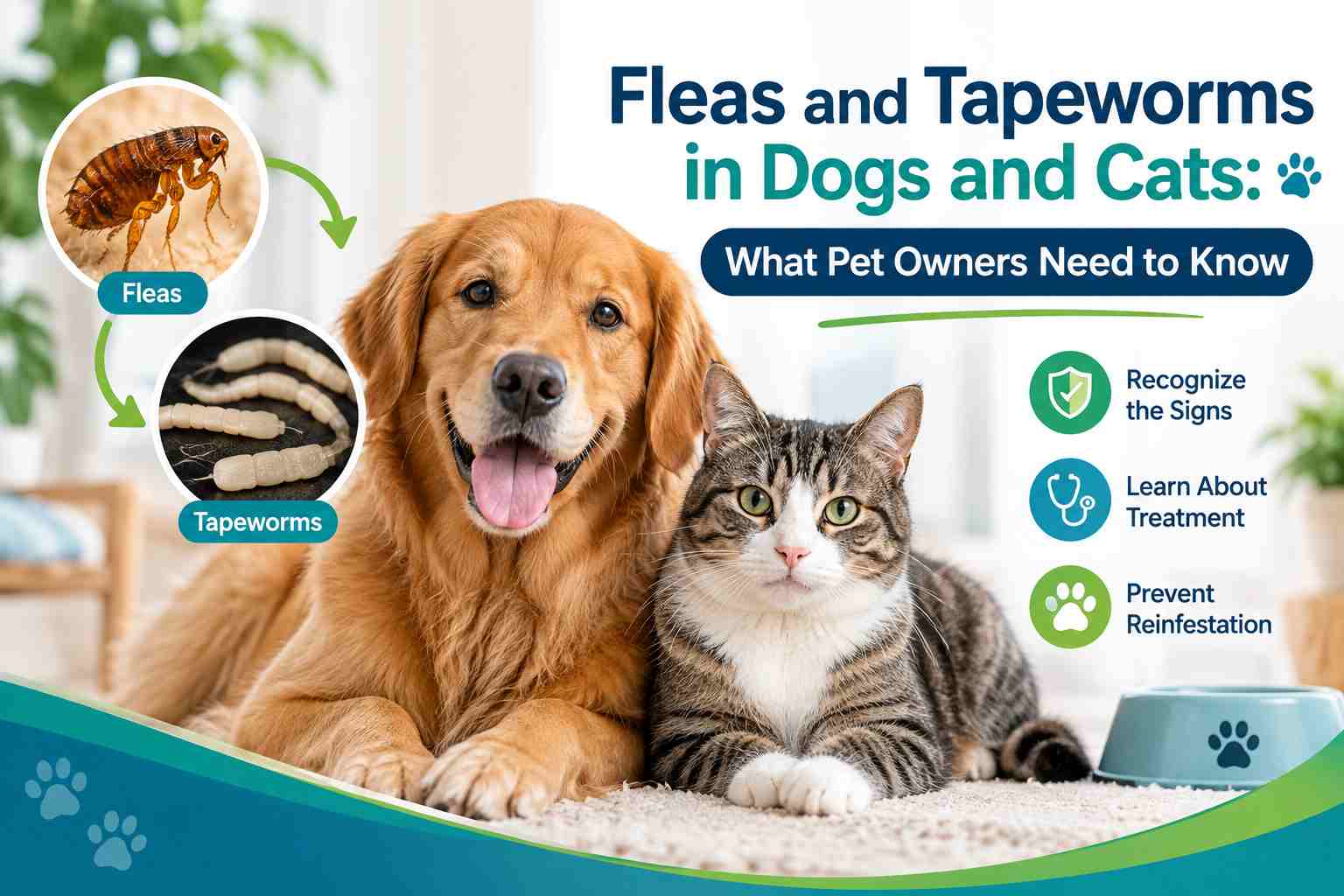
Fleas and Tapeworms in Dogs and Cats
Fleas and tapeworms are biologically linked in dogs and cats because pets become infected with the flea tapeworm (Dipylidium caninum) by swallowing an infected flea during grooming. Tapeworm dewormers (cestocides) remove existing intestinal worms, while continuous flea prevention is mandatory to stop immediate reinfection.
How Are Fleas and Tapeworms Related?
To understand how fleas and tapeworms are related, one must look at the lifecycle of the common dog and cat flea tapeworm, Dipylidium caninum. Many owners assume that tapeworms enter a pet when a flea bites the skin. In reality, the parasite must be swallowed alive.
The Centers for Disease Control and Prevention (CDC) and the Companion Animal Parasite Council (CAPC) outline the obligate intermediate host cycle:
- Tapeworm segments (proglottids) pass out of the pet’s digestive tract through feces or active migration through the anal sphincter.
- These proglottids rupture and release microscopic egg packets into carpets, pet beds, or garden soil.
- Flea larvae (which have chewing mouthparts) feed on organic debris and consume the tapeworm eggs.
- As the flea larva pupates and emerges as a biting adult flea, the tapeworm matures internally into an infective cysticercoid stage.
- When a dog or cat scratches or licks an itch caused by a flea bite, they inadvertently ingest the flea. Digestive enzymes dissolve the flea’s exoskeleton, freeing the juvenile tapeworm to attach to the lining of the pet’s small intestine.
Segment Shed
Pet sheds egg-filled proglottids onto bedding or carpet.
Larva Ingestion
Flea larvae consume eggs in home flooring.
Grooming Cycle
Pet bites an adult flea during grooming and swallows it.
Intestinal Growth
Tapeworm matures in 2–3 weeks, shedding new segments.
Fleas and Tapeworms in Cats
Understanding fleas and tapeworms in cats requires acknowledging feline grooming physiology. Cats spend up to 30% to 50% of their waking hours grooming. Their barbed papillae act as microscopic combs, capturing fleas before owners even realize an infestation exists. Consequently, an indoor cat with tapeworms almost always caught an elusive flea brought inside on shoes, visiting animals, or dog siblings.
Cat Tapeworm Symptoms
A healthy adult cat with a mild tapeworm infection rarely displays severe clinical illness. However, attentive owners can spot distinct cat tapeworm symptoms:
- Visible Proglottids: Fresh, crawling, cream-colored segments sticking to the perineal fur around the anus, base of the tail, or in freshly scooped litter boxes.
- Perianal Pruritus: Excessive licking, biting, or grooming beneath the tail, or scooting rear legs across rugs.
- Vomiting: Whole adult tapeworms can occasionally be regurgitated if they detach and irritate the stomach lining.
- Weight Loss with Ravenous Appetite: In heavy burdens or kittens, nutrient competition can cause a rough, dull coat and unthriftiness despite normal eating.
Fleas and Tapeworms in Dogs
Canines acquire fleas and tapeworms in dogs through similar grooming or flea-chewing patterns. Dogs often develop localized Flea Allergy Dermatitis (FAD) on their lower back, tail base, and thighs. In frantic attempts to relieve the intense itch, they chew vigorously at their skin, swallowing fleas in the process.
How Do Dogs Get Tapeworms?
While Dipylidium caninum via fleas is responsible for roughly 90% of household tapeworm cases, knowing how do dogs get tapeworms requires differentiating species. Fleas are not the only vector:
- Flea-Borne (Dipylidium caninum): Acquired through the ingestion of infected fleas.
- Prey-Borne (Taenia pisiformis & Taenia hydatigena): Acquired when hunting or scavenging dogs ingest wild rabbits, rodents, small mammals, or uncooked livestock offal harboring cysticerci in muscle or liver tissue.
- Echinococcus Species: Acquired in rural or farming regions via sheep, wild ungulates, or rodents. These pose significant zoonotic hydatid cyst risks to humans.
Because of this difference, if your dog is on strict prescription flea control but still sheds tapeworm segments, hunting behavior or raw wild game consumption is likely the culprit.
What Does Tapeworm in Dog Poop Look Like?
The search for tapeworm in dog poop is the most common way owners discover an infestation. Unlike roundworms (which resemble strands of spaghetti) or hookworms/whipworms (which are largely microscopic), tapeworms shed distinct physical segments called proglottids.
Fresh Stool / Fur Appearance
- Flat, rectangular or oval shaped.
- Measures roughly 1/4 to 1/2 inch in length.
- Moist and cream, white, or pale pink.
- Capable of slow, rhythmic stretching or crawling movements.
Dried Segment Appearance
- Dehydrated proglottids lose moisture quickly.
- Resemble hard, golden-brown or yellowed grains of white rice.
- Frequently found adhered to the fur around the anus, pet beds, couch cushions, or car seats.
Clinical diagnostic note: Standard veterinary fecal flotation tests frequently return a false-negative for tapeworms because tapeworm eggs are bound tightly within the proglottid segments and are not distributed evenly throughout stool samples. Visual identification of segments by the owner is the gold standard for clinical diagnosis.
Interactive Assessment: Does Your Pet Have Flea-Borne Tapeworms?
Select the observations matching your pet’s current state to calculate risk:
How to Treat Tapeworms and Fleas
Successfully learning how to treat tapeworms and fleas requires treating them as two halves of a single medical problem. Eradicating one without addressing the other guarantees ongoing reinfection.
Step 1: Eliminate the Tapeworms
Standard broad-spectrum over-the-counter dewormers containing only fenbendazole or pyrantel pamoate do not reliably eliminate Dipylidium caninum.
Veterinarians administer cestocides formulated with Praziquantel or Epsiprantel. These medications work by disintegrating the tapeworm’s protective outer tegument, causing the worm to be completely digested by the pet’s intestinal enzymes. You will rarely see dead worms passed after effective treatment.
Step 2: Break the Flea Cycle
Without rapid flea eradication, pets will ingest another infected flea within weeks.
Modern oral isoxazolines (for dogs) or advanced prescription topicals (for cats) kill biting adult fleas within hours—before they can reproduce. Environmental cleaning must follow to remove immature eggs and pupae from baseboards and carpets.
Flea and Tapeworm Treatment for Cats
Choosing a safe, reliable flea and tapeworm treatment for cats demands precision. Cats lack crucial liver glucuronidation enzymes, making them sensitive to improper drug classes.
| Treatment Type | Primary Actives | Target Parasites | Administration & Notes |
|---|---|---|---|
| Targeted Cestocide Tablet / Injection | Praziquantel or Epsiprantel | Tapeworms only (Dipylidium, Taenia) | Single oral dose or vet-administered subcutaneous injection. Does not kill fleas. |
| All-In-One Broad Spectrum Topical | Eprinomectin + Praziquantel (or similar combos) | Fleas, ticks, tapeworms, roundworms, hookworms, heartworm | Prescription spot-on applied to skin at skull base. Complete single-step parasite protocol. |
| Systemic Flea Control Only | Fluralaner, Sarolaner, or Spinosad | Adult fleas & ticks | Topical or oral chew. Kills the flea vector to prevent tapeworms, but does not cure active tapeworms. |
Is There a Medicine That Kills Fleas and Tapeworms?
Pet owners frequently ask: is there a med that kills fleas and tapeworms together?
The answer is yes, but only specific veterinary-formulated combination products. While classic flea preventatives (e.g., fipronil, imidacloprid) target the nervous system of insects, they have zero pharmacological effect against flatworms like cestodes.
To kill both parasites in a single dose, the medication must pair an ectoparasiticide with a dedicated cestocide (such as praziquantel). Always consult your veterinarian to verify that the product’s label explicitly lists Dipylidium caninum alongside flea control.
Can One Flea Treatment Prevent Tapeworms?
Flea treatments act as indirect prevention against tapeworms. By ensuring no fleas survive on your pet or in your home, you eliminate the vector required for the tapeworm to reach your pet’s stomach. However, giving a flea preventative to a pet that already has tapeworms will not cure the intestinal infection. A separate deworming agent is still necessary.
Flea Control Is Part of Tapeworm Prevention
Only 5% of a flea population lives on your pet as adult fleas. The remaining 95% exists inside your home environment as eggs (50%), larvae (35%), and pupae protected inside sticky cocoons (10%).
- Treat Every Pet in the Household: Untreated cats or small dogs act as continuous reservoirs, sustaining the flea-tapeworm chain even if one pet is medicated.
- High-Temperature Laundry: Wash pet blankets, bed covers, and throws weekly in hot water (minimum 140°F / 60°C) followed by high-heat drying.
- Frequent Vacuuming: Vacuum carpets, rugs, upholstered furniture, and car seats twice weekly. Empty the canister or dispose of the vacuum bag immediately outside to prevent flea larvae from developing indoors.
- Maintain a 90-Day Protocol: The flea lifecycle takes 3 to 12 weeks depending on ambient humidity and temperature. Flea prevention must be maintained continuously for at least three months to fully deplete pupal reserves.
Ultra-Fine Flea Combs
Essential for mechanically removing flea dirt and adult fleas from sensitive skin around the eyes and groin.
View Flea Combs on AmazonWashable Pet Bedding
Removable, zippered covers designed to withstand repeated high-heat washing cycles to kill larvae.
View Pet Bedding on AmazonHEPA Pet Hair Vacuum Tools
Deep-suction attachments to extract embedded flea eggs and pupae from baseboards and carpets.
View Vacuums on AmazonCan Humans Get Tapeworms From Dogs or Cats?
Humans can contract Dipylidium caninum, but infection is uncommon. A human cannot contract the parasite simply by petting an infected dog, cuddling a cat, or coming into direct contact with pet feces.
Just like pets, a person must accidentally swallow an infected flea. The CDC notes that the majority of diagnosed human cases occur in infants and toddlers. Children crawl on carpeted floors where flea eggs fall, stroke pets, and put their hands or flea-contaminated toys into their mouths.
Symptoms in children are usually mild, including digestive upset, irritability, and visible moving segments in diapers. Prevention focuses on consistent veterinary flea control, diligent handwashing, and prompt cleanup of pet waste.
When Should You Call a Veterinarian?
While uncomplicated tapeworm infections are easily handled, schedule a veterinary visit right away if you notice any of the following clinical signs:
- Infections in puppies or kittens under 8–12 weeks of age. Heavy flea burdens can cause life-threatening flea-anemia.
- Severe lethargy, pale gums, weakness, or unexplained weight loss.
- Persistent vomiting, diarrhea, or signs of abdominal discomfort.
- Inability to keep food or water down.
- Reappearing tapeworm segments despite recent over-the-counter deworming.
Essential Pet Health Calculators & Guides
Weight management and precise nutrition are vital to maintaining your pet’s immune resilience against parasites. Explore our evidence-based tools on PetMealGuide:
Frequently Asked Questions
After a pet swallows an infected flea, the juvenile tapeworm cysticercoid attaches to the intestinal wall and matures into an egg-shedding adult tapeworm in approximately 2 to 3 weeks (14 to 21 days).
Tapeworm dewormers (praziquantel/epsiprantel) kill existing worms inside the gut within 24 hours, but they have zero residual protective activity. If there are still fleas on your pet or in your home, your dog or cat can ingest another flea and develop a brand-new tapeworm infection within 2 to 3 weeks.
Yes. Fleas easily hitchhike into homes on human clothing, shoes, or visiting outdoor pets. Even a single infected female flea entering an apartment can lead to grooming ingestion and a tapeworm infection in an indoor cat.
No. Natural remedies like garlic, pumpkin seeds, and apple cider vinegar are clinically ineffective against established tapeworms and fleas. Furthermore, allium vegetables like garlic and onions are toxic to dogs and cats, causing hemolytic anemia.
1 thought on “Fleas and Tapeworms in Dogs and Cats: What Pet Owners Need to Know”